
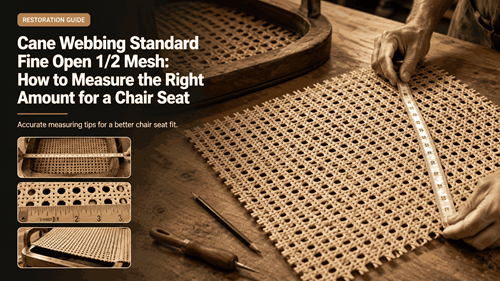
Cane Webbing Standard Fine Open 1/2 Mesh is a prewoven material, so the most important buying decision happens before any soaking or installation begins: the sheet must cover the chair opening with enough extra material to reach the entire groove. Measuring only the visible opening can leave the webbing too short to seat securely under the spline.
For a first pressed-cane repair, measure the groove-to-groove dimensions rather than copying the old broken sheet. Add a practical cutting margin on every side, confirm the roll width is sufficient, and keep the mesh square to the chair frame. A few careful measurements prevent most last-minute stretching and trimming problems.
How To Measure Cane Webbing Standard Fine Open 1/2 Mesh
Pressed cane seats use a continuous groove around the opening. The webbing spans the opening, turns down into that groove, and is held by reed spline. Because the cane disappears below the finished surface, the cutting size must be larger than the opening you can see from above.
Use a steel tape for the overall dimensions and a smaller ruler or caliper to inspect the groove. Measure the widest points, especially on trapezoid or slightly curved seats. If the frame is not perfectly square, record front width, rear width, left length, and right length instead of assuming one measurement represents every side.
The half-inch fine-open pattern is visually regular, so orientation matters as well as coverage. Plan the cut so the mesh rows run straight relative to the chair rails. A sheet that is large enough but rotated or skewed can make the finished seat look uneven.
Planning Width, Allowance, And Mesh Orientation
Start With Groove-To-Groove Sizing
For reliable fine open cane mesh sizing, compare the chair’s maximum groove-to-groove width with the listed webbing width before ordering.
Take the measurement at several points because old wooden frames can move slightly over time. When the front and back dimensions differ, plan for the larger figure and trim the excess after the mesh is fully positioned.
Measure The Seat, Not The Old Cane
A careful chair seat webbing measurement should come from the frame itself because the removed cane may have shrunk, cracked, or torn away from the original groove line.
Mark each dimension on paper and sketch the seat shape. This simple record is useful when comparing 18-inch, 24-inch, and wider rolls and reduces the chance of ordering a sheet that covers the center but not the corners.
Check Whether An 18-Inch Roll Is Truly Wide Enough
Use 18 inch cane webbing planning only after adding the groove depth and working allowance to the visible seat width.
A seat that measures close to 18 inches across the groove usually needs a wider sheet because you still need material to push into both sides. Choosing a wider roll is preferable to trying to stretch dry cane beyond its natural dimensions.
Confirm The Construction Uses Pressed Cane
The correct prewoven cane seat material is intended for a routed groove and spline system, not a chair drilled with individual perimeter holes.
If the frame has holes instead of one continuous groove, the chair was designed for hand caning and should be repaired with individual strands. That distinction should be settled before any webbing is cut.
Leave A Cutting Margin Around The Whole Seat
A sensible cane sheet cutting allowance gives you enough material to align the pattern, press it into the groove, and trim cleanly after the fit is confirmed.
Cut the initial rectangle generously instead of trying to match the final seat shape on the first pass. Curves and corners are easier to manage once the sheet is centered and temporarily held in position.
Dry-Fit Before Soaking Or Gluing
Good open mesh installation prep includes a full dry-fit of the sheet, spline, wedges, and groove before final assembly.
The dry-fit is the moment to correct pattern direction, identify tight corners, and confirm the spline size. Once wet cane is in the groove, every unnecessary adjustment increases handling and can distort the mesh.
Webbing Size Decision Table
Use the chair dimensions plus working allowance to decide which stock width gives a comfortable installation margin.
| Measured Groove Width | Working Width to Plan | Buying Decision |
|---|---|---|
| Up to about 14 in | About 17–20 in | 18 in may work if allowance is confirmed |
| 14–18 in | About 17–24 in | Check 18 in carefully; 24 in is often safer |
| 18–22 in | About 21–28 in | Choose at least 24 in when the full cut fits |
| Irregular or curved seat | Use maximum width plus allowance | Make a paper pattern before cutting |
| Multiple matching chairs | Measure every frame | Do not assume all seats are identical |
Cut And Prepare The Sheet In A Controlled Sequence
Work on a clean flat surface. Cane catches easily on rough edges, screws, and splinters, so clear the bench before unrolling the sheet. Keep the factory edge intact until you have confirmed the final orientation.
Pre-Cut Checklist
- Measure outside groove edge to outside groove edge
- Record front and rear widths separately
- Record left and right lengths
- Add working allowance on every side
- Confirm stock width before ordering
- Align the mesh rows with the chair frame
- Dry-fit spline and wedges
- Mark the cut line with a light removable reference
- Cut only after orientation is confirmed
When several chairs are involved, label each cut sheet to its specific frame. Small differences in old furniture are common, and swapping two pieces can turn a good measurement into an unnecessary trimming problem.
Measurement Mistakes That Waste Good Webbing
The most common error is buying webbing to the visible opening size. The groove consumes extra material, so the sheet must extend beyond the opening before it can be secured. Another mistake is using the damaged old cane as a pattern after it has shrunk or lost its edges.
Avoid stretching a short sheet to make it reach. Natural cane changes as it is moistened and dries under tension, but installation should not depend on forcing material beyond the dimensions you planned.
For a broader material reference, the Canadian Conservation Institute explains cane, wicker, plant-fibre construction, moisture response, and handling in its basketry and plant materials guidance.
Measure Generously And Trim After The Fit Is Proven
Cane Webbing Standard Fine Open 1/2 Mesh is straightforward to install when the sheet is sized around the groove rather than the visible opening. Measure the frame, add working allowance, confirm roll width, and keep the pattern square.
The goal is not to buy the smallest possible piece. A controlled margin gives you room to position the mesh correctly and creates a cleaner, less stressful installation.
Frequently Asked Questions
How much extra cane webbing should I allow around a chair seat?
A practical starting point is roughly 2 to 3 inches of extra material on the width and length when the sheet size permits, but the groove depth and seat shape should guide the final allowance.
Can I use 18-inch webbing on an 18-inch groove-to-groove seat?
Usually that leaves too little or no working margin. Calculate the full cut width, including the material that must enter both grooves, before choosing the roll.
Should I measure the old cane sheet?
Use the chair frame as the primary reference. Old cane can shrink, tear, or lose its original edges.
Does the mesh direction matter?
Yes. Straight, centered rows make the finished seat look intentional and help keep tension visually even.
Should the cane be soaked before measuring?
No. Complete the frame measurement, cutting plan, and dry-fit first, then follow appropriate preparation instructions for the material.
