
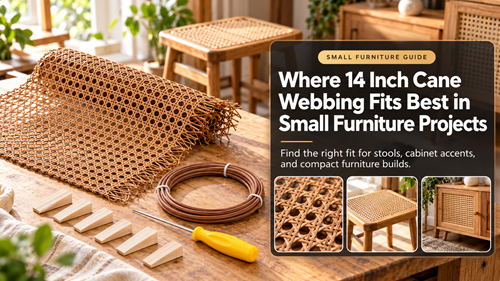
14 Inch Cane Webbing is useful when a furniture opening is narrow enough that a larger roll would create unnecessary offcuts. Small chair backs, cabinet inserts, bedside tables, decorative drawer fronts, and compact screens can all fit this width when the actual fastening area stays comfortably inside the roll.
The key word is comfortably. A visible opening close to 14 inches may require a wider product once the hidden groove, overlap, or retaining area is included. Measure the frame construction before choosing a roll by nominal width.
Where 14 Inch Cane Webbing Works Best
Start with Narrow Chair Backs
For small chair backs, measure the complete groove or retaining area rather than only the visible opening. A 10- or 11-inch opening can be a good candidate for a 14-inch roll when there is still enough webbing around the edges to secure and trim it.
Chair backs are often easier to handle than seats because they carry less direct body weight, but the frame construction still determines the correct material. A drilled-hole back needs hand cane rather than pressed webbing.
Compare Roll Width with the Finished Cut
Products described under 14 inch cane webbing sizes can vary in roll length, weave, and exact construction. Confirm the stated width and calculate whether the full cut can remain inside it with usable margin on both sides.
If the required cut is 13.5 inches wide, a nominal 14-inch roll leaves very little room for alignment or trimming. A wider roll is usually a safer choice than forcing an exact fit.
Use the Width for Small Decorative Inserts
Common 14 inch cane webbing uses include cabinet panels, small screens, chair backs, drawer fronts, and other narrow furniture details. The smaller width can reduce waste when many pieces share similar dimensions.
Before cutting a full set, place the weave over one opening and judge the pattern scale. A large mesh can overwhelm a narrow rail, while a denser square or radio weave may suit a compact panel better.
14 Inch Cane Webbing Buying Guide for Compact Projects
Compare Width, Length, and Pattern Together
Use a broader 14 inch cane webbing buying guide approach: the right roll must be wide enough, long enough for every planned cut, and visually compatible with the furniture. A low-cost roll can become expensive if its pattern or dimensions force several unusable offcuts.
Sketch the cuts along the roll length before ordering. For repeated cabinet or chair-back panels, keep all pieces in the same weave orientation so the finished set looks intentional.
Match the Material to the Furniture
Compare small chair backs materials by natural rattan content, weave style, colour, and installation requirements. Natural material is appropriate for many indoor restorations, but it can vary slightly in tone and strand character.
If the project must match an older chair, save a clean section of the original cane. Use it to compare mesh opening, strand width, and colour before the replacement is cut.
Install without Wasting the Narrow Roll
For practical small chair backs installation tips, mark the center of the frame and the cane, test the fit before soaking, and trim only after the sheet is positioned correctly. Narrow rolls leave less room for a major alignment correction.
Support curved or tapered frames with a paper template when necessary. A template helps identify the widest point and prevents a piece from being cut too close on one edge.
14 Inch Cane Webbing Project Fit Guide
Use this table to decide whether a narrow roll genuinely saves material or creates too little working margin.
| Project Type | Fit Question | What to Watch |
|---|---|---|
| Small chair back | Does the outside groove fit inside 14 inches? | Leave margin beyond the groove |
| Cabinet insert | Does the hidden overlap fit inside the roll? | Measure behind the face frame |
| Drawer front | Is the weave scale appropriate? | Large mesh can dominate small panels |
| Decorative screen | Can all cuts share one orientation? | Keep pattern direction consistent |
| Multiple pieces | Is the roll long enough for the cutting layout? | Plan offcuts before ordering |
| Tapered frame | What is the widest point? | Use maximum dimensions, not the center only |
Measure Small Furniture before Cutting the Roll
Compact Project Checklist
- Identify the frame fastening method
- Measure the widest point
- Add hidden overlap or groove margin
- Keep a sample of the original weave
- Choose the weave orientation
- Plan every cut along the roll
- Check colour in natural light
- Follow preparation directions
- Trim after the material is positioned
When a project is only slightly narrower than 14 inches, compare the cost of a wider roll with the risk of losing a piece to a measurement or alignment error. Extra width can be worthwhile on an irregular frame.
Save useful offcuts flat or loosely rolled. Small pieces can later be used for colour matching, a repair sample, or testing finish compatibility.
Use 14 Inch Cane Webbing Where the Full Cut Fits Comfortably
14 Inch Cane Webbing is most efficient on genuinely narrow furniture parts, not on openings that merely happen to be under 14 inches. Include the groove or fastening overlap in the measurement before deciding that the smaller roll is suitable.
For compact chair backs and cabinet panels, a careful cutting plan can reduce waste and keep the weave consistent. If working margin becomes tight, move to a wider roll rather than compromising the installation.
Frequently Asked Questions
What size opening is suitable for 14-inch cane webbing?
There is no single maximum because the required margin depends on the fastening method. The complete cut, not just the visible opening, must fit comfortably within the roll.
Is 14-inch webbing only for chair backs?
No. It can suit narrow cabinet inserts, drawer fronts, small screens, and other decorative furniture panels when the material and mounting method are appropriate.
Can I use 14-inch webbing on a chair seat?
Yes when the seat is designed for compatible pressed webbing and the complete groove dimensions leave enough working margin within the roll.
What if the frame is almost 14 inches wide?
Choose a wider roll if the installation margin is too small. An exact-width fit leaves little room for centering and trimming.
Does a narrower roll mean the weave pattern is smaller?
No. Roll width and weave scale are separate specifications. Check the mesh pattern independently.
