
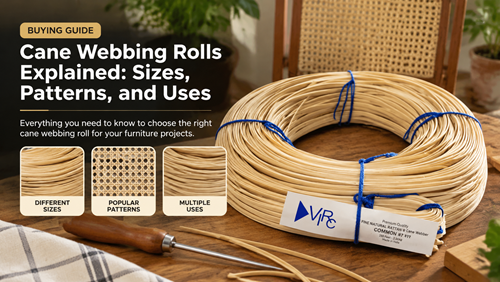
Cane webbing rolls are sold in many widths, lengths, and patterns, but the roll dimensions are only the starting point. A useful comparison also considers mesh scale, pattern direction, natural material variation, the size of the finished opening, and whether the cane will be structural or decorative.
For chair repair, the frame construction controls the choice. For cabinets and wall panels, appearance and fastening method may have more flexibility. Planning the cut layout before buying can reduce waste on multi-panel projects.
Compare Cane Webbing Rolls by Pattern and Mesh Scale
Read the Pattern before the Price
Different cane sheet patterns change the visual weight of a chair, cabinet, or screen. Hexagonal open mesh is common, but square, radio, close-woven, and decorative patterns can look very different at the same roll width.
Match pattern scale to the furniture. A large mesh can overwhelm a narrow chair back, while a dense pattern may appear heavy in a wide decorative panel.
Use Open Mesh Where Airflow and Light Matter
Classic open weave cane exposes more of the opening and gives furniture a lighter look. It is often used on chair backs, cabinet doors, radiator-style panels, and pressed-cane seats designed for open mesh.
Open mesh also makes misalignment easy to see. Square the pattern to the frame before cutting so vertical and horizontal lines do not appear to drift across the finished panel.
Choose Finer Weave for Smaller Visual Scale
A fine weave cane pattern can suit compact openings or furniture where the existing cane uses narrow strands and smaller mesh. Compare the actual mesh dimensions rather than relying only on words such as fine or standard.
If you are restoring a matching pair, measure both pieces. Small differences in frame opening or old weave tension can change how the same replacement material looks after installation.
Plan Furniture Cane Rolls and Replacement Sheets
Buy Roll Length for the Cut Plan
Longer furniture cane rolls are useful when several cabinet doors or chair backs share one material. Draw each required rectangle on paper and orient the pattern consistently before calculating total length.
Add space between cuts and allow for defects or natural variation. A theoretical zero-waste layout is rarely practical when every finished panel needs clean edges and matching orientation.
Use Replacement Sheets on Groove-Style Seats
Pre-woven replacement cane sheets can simplify a single chair repair when the frame has a continuous routed groove. The sheet still needs enough overhang to be tamped into the groove and trimmed afterward.
Do not trim the webbing to the visible opening before installation. Once the sheet is cut too small, there may not be enough material to seat it securely around the perimeter.
Select Material by Project, Not Trend
Good craft material selection considers structure, indoor or outdoor exposure, fastening method, finish, and maintenance. Natural rattan works beautifully indoors but is not automatically the right choice for every damp or exposed location.
Synthetic webbing can be useful for selected environments, but it has different cutting, fastening, and appearance characteristics. Follow the specific product instructions rather than treating it like natural cane.
Roll Size and Use Planning
Use this comparison as a planning aid. The furniture frame, product specifications, and installation method should always take priority over a generic rule.
| Project | Important Roll Dimension | Pattern Check |
|---|---|---|
| Chair back | Width plus trimming margin | Match existing orientation |
| Pressed-cane seat | Opening plus groove margin | Match original mesh |
| Cabinet doors | Number of panels across roll | Keep pattern aligned |
| Headboard or screen | Large continuous width | Check seam-free coverage |
| Small crafts | Offcut-friendly width | Choose scale that suits project |
Store and Cut Cane Rolls Carefully
Before You Commit to the Final Cut or Installation
- Store rolls loosely and dry
- Measure every opening individually
- Mark pattern direction before cutting
- Use sharp scissors or a clean blade
- Leave working margin around each piece
- Avoid hard folds and creases
- Prepare natural cane only as instructed
- Keep unused material protected from crushing
Peerless Rattan provides free pressed-cane and seat-weaving tutorials that help connect roll selection with the actual installation method.
Keep measurements, product labels, and a small offcut after the project. Those records make future maintenance or a matching second repair much easier than trying to identify the material years later.
Plan the Project with Fewer Surprises
Cane webbing rolls are easiest to compare when size, pattern, and project method are considered together. A low price per foot is not useful if the roll is too narrow, the mesh is wrong, or the cut plan wastes most of the material.
Measure the finished openings, decide the pattern direction, and buy enough working margin to install and trim confidently.
Frequently Asked Questions
What roll width should I buy?
Choose a width that covers the largest opening plus the working margin required by the installation method. Measure the widest point, not just the centre.
Can I rotate cane webbing to fit a narrower roll?
Rotation changes pattern orientation and may look wrong beside other panels. Confirm the weave looks correct before planning cuts.
Is fine weave stronger than open weave?
Pattern density alone does not determine suitability or strength. Material quality, strand size, installation, and intended use all matter.
Can one roll be used for chairs and cabinets?
Possibly, if the material, dimensions, pattern, and installation method suit both projects.
How should leftover cane webbing be stored?
Keep it clean, dry, loosely rolled, and protected from hard bends or crushing until the next project.
