
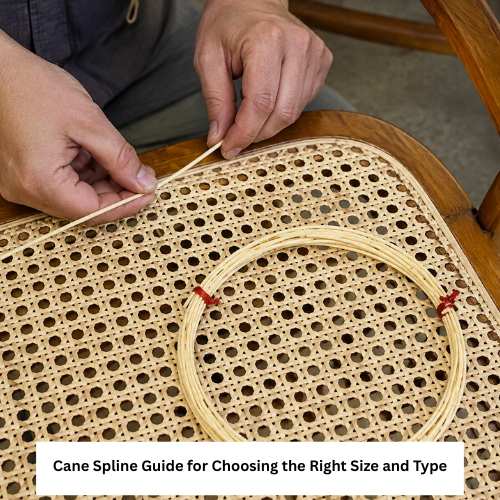
Choosing the correct cane spline is essential when installing pressed cane webbing in a chair seat, back, cabinet panel, or decorative furniture opening. The spline must fit the groove together with the webbing without sitting loosely or requiring enough force to damage the frame.
Buyers should measure the cleaned groove, identify the webbing material, compare spline diameter and shape, and confirm how much length is required. An old spline can provide a starting reference, but it may be compressed, swollen, brittle, or incorrect from a previous repair.
How to Measure Cane Spline Size
Remove the old material and clean the groove before taking a final measurement. Old glue, cane fibers, dirt, and broken spline can make the groove appear narrower than it is.
Measure the groove at several points using a caliper or another accurate tool. Record both width and depth.
The right cane spline must account for:
- Groove width
- Groove depth
- Webbing thickness
- Natural or synthetic material
- Chair frame condition
- Curve or corner shape
- Adhesive allowance
- Original installation method
Do not choose spline by seat size alone. Two chairs with similar seat openings may use different groove sizes.
A number 8 reed spline for a 3 16 inch groove can be compared when the cleaned groove and webbing system match, but verify the seller’s current measurements before buying.
| Check | What to Measure | Key Note |
| Multiple groove sections | Front, rear, left, right, corners, old joint area | Large differences may indicate groove damage. |
| Old spline | Measure only as a secondary reference | Old spline may shrink, flatten, swell, or contain adhesive. |
| Webbing thickness | Test webbing and spline together | Fit should be firm without crushing fibers or splitting wood. |
Understanding Spline Numbers
Reed spline is often sold with size numbers such as number 7, number 8, number 9, or another designation. The number may be paired with an approximate diameter or groove recommendation.
Do not assume that every supplier uses the number in exactly the same way. Compare the actual stated measurement.
A Commonwealth Basket number 9 reed spline can be considered for a compatible chair groove, but verify the current diameter, length, and webbing requirements before ordering.
A Commonwealth Basket RS872 number 8 spline provides another product option for comparing a smaller reed size, although buyers must confirm the actual groove and webbing fit.
Keep a written record of the product number and measured diameter when a size works correctly. This makes future cane seat repair easier.
Natural Reed Spline
Natural reed spline is commonly paired with natural pressed cane webbing. It can provide a traditional appearance and may accept compatible finishing products.
Natural material can react to moisture and storage conditions. Follow the supplier’s preparation instructions.
Do not leave natural spline soaking for an unverified period. Excess moisture can soften or distort it.
Inspect natural spline for:
- Cracks
- Splits
- Flat areas
- Discoloration
- Mold
- Brittle sections
- Large diameter changes
- Rough fibers
A coil should straighten enough for installation without cracking. Do not force dry, brittle material around a tight curve.
Synthetic Spline
Synthetic spline may be used with synthetic cane webbing or furniture designed for synthetic repair materials.
Potential advantages can include consistent size and reduced moisture response, but compatibility must be verified.
Do not automatically combine synthetic spline with natural webbing. Differences in flexibility, adhesive bonding, and expansion may affect the installation.
Check:
- Material type
- Required adhesive
- Heat sensitivity
- Indoor or outdoor suitability
- Color
- Diameter
- Flexibility
- Storage instructions
Do not heat synthetic spline to make it bend unless the product instructions specifically allow it.
Spline Shape and Groove Compatibility
Most pressed cane chair repairs use round reed spline, but some furniture may use a different profile.
The groove shape should match the holding material.
Possible profiles include:
- Round reed spline
- Slightly oval or compressed reed
- Synthetic round spline
- Specialty furniture spline
- Decorative trim used in non-seat applications
Do not substitute flat reed, binder cane, or random cord for chair repair spline. These materials may not hold the webbing correctly.
A three size chair caning spline kit can help buyers compare several diameters before choosing, but every included size, length, and material should be verified.
Calculating How Much Spline to Buy
Measure the entire distance around the groove. Add a reasonable fitting allowance for the joint and trimming.
Do not estimate only from the chair width and depth because curved corners increase the total length.
For an irregular opening:
- Use a flexible measuring tape.
- Press the tape along the center of the groove.
- Measure the full perimeter.
- Repeat the measurement.
- Add allowance for trimming and mistakes.
- Consider buying extra for testing.
A coil can be convenient for several repairs, but it must be stored correctly to prevent cracking, mold, or distortion.
Short lengths may be easier for one chair, provided the piece is long enough to complete the groove without an unwanted extra joint.
Matching Spline to Webbing
The webbing and spline work as a system. A spline that seems correct by itself may not work with a thicker webbing pattern.
Check:
- Webbing material
- Mesh thickness
- Border thickness
- Groove dimensions
- Spline diameter
- Adhesive recommendation
- Installation wedge size
- Required soaking or preparation
A coarse or heavy webbing may need a different fit from fine open cane mesh.
The correct cane spline should hold the webbing firmly while allowing controlled installation around corners.
Do not reduce webbing thickness by scraping or cutting the fibers that sit in the groove.
Common Buying Mistakes
Avoid these mistakes:
- Buying spline before cleaning the groove
- Selecting by the old flattened spline alone
- Assuming size numbers are universal
- Measuring only one part of the groove
- Forgetting the webbing thickness
- Using flat reed instead of spline
- Mixing natural and synthetic systems without checking
- Buying too little length
- Ignoring curves and perimeter allowance
- Using oversized spline to compensate for a damaged groove
- Choosing glue before checking material compatibility
- Cutting or soaking the spline before checking the return policy
- Ignoring delivery damage
- Buying a bulk coil without proper storage space
Buyers can review a chair caning spline coil for a routed groove as an external comparison, then verify the current diameter, material, length, seller, and return policy.
Conclusion
The correct cane spline is selected by measuring the cleaned groove, accounting for webbing thickness, and comparing actual material dimensions. Test the fit before applying adhesive and never force an oversized piece into a fragile wooden groove. Cane weaving supplies offers reed spline, assorted size packs, webbing kits, and caning tools for chair repair buyers who need compatible materials.
FAQ
How do I know what size cane spline to buy?
Measure the cleaned groove width and depth, then account for the webbing thickness. Compare the measurements with the supplier’s sizing guidance.
Can I reuse old chair caning spline?
Old spline is usually compressed, brittle, or covered with adhesive. New correctly sized material is generally a better choice.
Does spline size have to match the groove exactly?
It must fit the groove together with the webbing. An empty-groove fit does not confirm final compatibility.
Can I use natural spline with synthetic webbing?
Only when the material suppliers confirm compatibility. Adhesive, expansion, and flexibility may differ.
How much spline do I need for one chair?
Measure the complete groove perimeter and add allowance for the joint, trimming, and a test section.
