
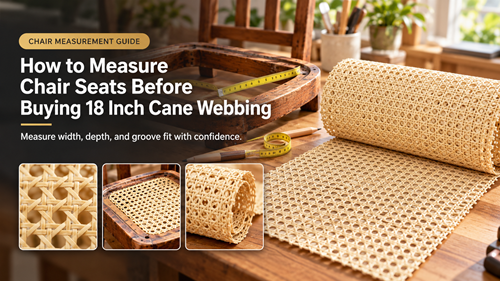
Buying 18 Inch Cane Webbing starts with the chair frame, not the number printed on a roll. An 18-inch product can work well for many pressed-cane chair seats, but only when the usable opening, groove position, weave direction, and installation margin all fit inside that width.
Measure before removing more material than necessary. Record the widest and longest points of the seat, photograph the old weave, and confirm whether the frame uses a continuous routed groove or individual drilled holes. Those details determine whether pre-woven webbing is appropriate at all.
How 18 Inch Cane Webbing Fits a Chair Seat
Confirm the Caning Method Before Measuring
A practical chair seat replacement begins by identifying the frame. A continuous groove around the seat opening normally indicates pressed cane webbing held with spline. Drilled holes around the perimeter indicate traditional hand caning and require a different material system.
Do not assume a seat is pressed cane just because the old surface looks pre-woven. Check the underside and edge of the frame. Saving a photo and a small sample of the old material makes pattern matching and later reassembly easier.
Measure the Groove, Not Only the Visible Opening
When comparing 18 inch cane webbing sizes, measure from the outside edge of the groove on one side to the outside edge of the groove on the opposite side. Repeat at several points because older chair frames are not always perfectly square.
Record both maximum width and maximum length. The visible center opening is smaller than the material you need because the webbing must cross the groove and still leave enough excess for positioning, tamping, and trimming.
Allow Working Margin Around the Seat
Different 18 inch cane webbing uses may list the same width but differ in roll length, pattern, mesh scale, and natural rattan character. For a chair seat, the roll width must cover the full groove dimension with extra material available on both sides.
Do not plan to cut exactly to the groove before installation. Keeping the sheet larger during fitting gives you something to hold and adjust, especially at curved corners or a seat that narrows toward the back.
18 Inch Cane Webbing Buying Guide for Seat Planning
Match the Pattern Before You Cut
Use an 18 inch cane webbing buying guide to compare weave pattern, strand spacing, roll dimensions, and material type before ordering. A width that fits mechanically can still look wrong if the replacement mesh is much larger or denser than the original.
Orient the weave before trimming. On a rectangular or trapezoidal seat, the visual centerline should remain straight relative to the chair frame. A small alignment error becomes more noticeable after the spline locks the sheet in place.
Plan the Supporting Repair Materials Together
Treat the webbing, spline, wedges, chisel, cutting tool, and glue as one group of chair seat replacement materials. Measuring the clean groove after the old spline is removed is more reliable than copying a compressed or brittle old spline.
If the groove still contains dried glue or broken reed, clean it before taking the final spline measurement. Forcing an oversized spline can damage the groove, while an undersized spline may fail to hold the webbing securely.
Prepare the Material Before Installation
For practical chair seat replacement installation tips, follow the product soaking instructions, test the weave orientation, and make sure the sheet is centered before pressing it into the groove. Natural rattan should be handled gently while wet and should dry fully before the chair returns to regular use.
Avoid trying to create final drum-tight tension while the material is wet. Correct pressed-cane installation relies on even placement and the natural tightening that occurs as properly prepared cane dries.
18 Inch Cane Webbing Measurement Checklist
Use these measurements as a project worksheet before placing an order. The exact installation method and product instructions still take priority.
| Measurement | What to Record | Why It Matters |
|---|---|---|
| Frame method | Groove or drilled holes | Determines pressed webbing versus hand cane |
| Maximum groove width | Outside edge to outside edge | Confirms whether 18-inch width provides working margin |
| Maximum groove length | Longest point front to back | Determines required roll length |
| Pattern | Mesh opening and orientation | Keeps the replacement visually consistent |
| Groove width | Clean channel measurement | Helps select the spline size |
| Seat shape | Square, curved, or tapered | Changes cutting and alignment needs |
Prepare the Chair Before the Final Cut
Pre-Order and Pre-Installation Checks
- Photograph the original seat
- Confirm groove versus drilled-hole construction
- Measure width at several points
- Measure the longest front-to-back dimension
- Clean the groove before sizing spline
- Compare the old weave pattern
- Plan generous working margin
- Read soaking directions
- Dry-fit orientation before trimming
Keep the original measurements with the product name and a small offcut after the repair. That record is useful if the same chair set needs another seat later.
If the 18-inch roll is only barely wider than the outside groove measurement, choose a wider product rather than relying on an exact edge-to-edge fit. Working margin makes alignment, wedging, and trimming safer.
Choose 18 Inch Cane Webbing from the Frame Measurements
The best 18 Inch Cane Webbing choice is the one that covers the complete groove footprint, matches the intended weave, and leaves enough excess for installation. Measuring only the visible opening can lead to a sheet that is too narrow when it reaches the groove.
Identify the caning method first, clean the groove, measure at several points, and plan the spline and tools at the same time. That preparation reduces wasted material and makes a pressed-cane seat easier to align.
Frequently Asked Questions
Is 18-inch cane webbing wide enough for every chair seat?
No. Compare the roll width with the maximum outside-to-outside groove dimension and allow working margin on both sides.
Should I measure the old cane sheet or the chair frame?
Use the cleaned chair frame as the primary reference. Old cane may have shrunk, torn, or been cut very close to the groove.
How much extra webbing should extend past the groove?
The exact amount depends on the frame and installation method, but the sheet should extend far enough to position, wedge, and trim it without running short.
Can 18-inch webbing replace a hand-caned seat?
Not as a direct replacement when the frame uses drilled holes. Hand-caned frames normally require individual strands.
Should the spline be ordered from the old spline size?
Measure the cleaned groove. Old spline may be compressed, swollen, or covered in glue and can give a misleading size.
