
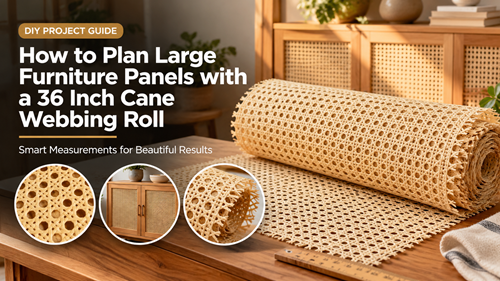
A 36 Inch Cane Webbing Roll gives furniture makers more freedom on wide cabinet doors, headboards, screens, credenza fronts, and large decorative panels. The extra width can reduce seams and allow one continuous field of cane, but it also makes measurement, pattern alignment, handling, and cutting more important.
Wide material becomes expensive quickly when a cut is made in the wrong direction or a panel is measured only at the center. Plan the entire project on paper first, then confirm the widest opening, hidden fastening area, weave direction, and roll length before making the first cut.
Plan Wide Panels with a 36 Inch Cane Webbing Roll
Measure the Largest Panel at Every Edge
For wide woven panels, measure top, middle, bottom, left, center, and right rather than assuming the frame is square. Large furniture openings can vary enough that a cut based on one dimension becomes short at a corner.
Add the hidden fastening area after the visible opening is recorded. Cabinet trim, rear retaining strips, routed grooves, and wraparound mounting methods all require different amounts of extra material.
Treat Width and Roll Length as Separate Limits
Comparing 36 inch cane webbing roll sizes means checking both the 36-inch sheet width and the total available length. A project may fit easily across the width but still require more linear material than one roll provides.
Draw every panel as a rectangle on a cutting map. Include trim allowance and keep all matching panels in the same weave orientation before calculating the final roll length.
Use Wide Cane where a Seam Would Distract
Common 36 inch cane webbing roll uses include large cabinet faces, room-divider inserts, headboard panels, broad furniture doors, and decorative wall or ceiling details. The wider sheet is most valuable when one continuous weave improves the finished appearance.
A 36-inch roll is not automatically the best value for small pieces. If most cuts are narrow, compare a smaller roll to avoid paying for wide offcuts that have no planned use.
36 Inch Cane Webbing Roll Buying Guide for Large Projects
Map Every Cut before Ordering
Use a 36 inch cane webbing roll buying guide approach that includes all panels, not one representative opening. Number the cuts, add their lengths, and reserve space for alignment, defects, and the material lost between irregular shapes.
For a matched cabinet set or headboard, buying enough material in one batch also improves colour consistency. Natural cane can vary slightly from roll to roll.
Support the Material while Handling It
Wide wide woven panels materials can flex and crease if the roll is allowed to fold under its own weight. Use a clean table or floor surface large enough to support the sheet while measuring and marking.
Mark cut lines lightly on the hidden side and verify the pattern before cutting. A long straightedge and repeated measurement checks are more reliable than following the weave by eye.
Install from a Centerline
For practical wide woven panels installation tips, mark the center of both the furniture opening and the webbing. Secure the panel gradually from opposite sides so the pattern stays square and does not drift as tension is added.
If the cane requires soaking, follow the product directions and prepare a work area large enough for the wet sheet. Avoid folding softened cane sharply, because a crease can distort the weave or break strands.
36 Inch Cane Webbing Roll Project Planning Table
Use a full-project plan to decide whether the wide roll reduces seams and waste enough to justify the larger format.
| Planning Item | What to Record | Why It Matters |
|---|---|---|
| Largest panel width | Maximum complete cut width | Confirms the 36-inch sheet is sufficient |
| Panel length | Cut length for each opening | Determines total roll length |
| Fastening overlap | Hidden margin around each panel | Prevents undersized cuts |
| Weave direction | Top-to-bottom pattern orientation | Keeps multiple panels consistent |
| Cut map | Order of pieces along the roll | Reduces waste |
| Handling area | Clean support surface size | Prevents creasing of wide material |
Prepare a Wide-Roll Cutting Plan
Large Panel Checklist
- Measure every panel separately
- Use maximum dimensions
- Add fastening margin
- Choose one weave direction
- Draw a full cut map
- Reserve defect and alignment allowance
- Support the roll while uncoiling
- Mark from a centerline
- Trim only after fit is confirmed
Keep a clean offcut that shows the weave and colour. If more material is needed later, the sample provides a better comparison than a photograph alone.
For very long installations, work with a second person when possible. Supporting the opposite side of a wide sheet makes it easier to keep the material flat and prevents accidental folding while positioning it.
Use the 36 Inch Cane Webbing Roll to Reduce Seams and Waste
A 36 Inch Cane Webbing Roll is most valuable when a wide furniture project can be covered with continuous pieces that smaller rolls cannot provide. The advantage comes from planning the whole cutting layout before any material is trimmed.
Measure every edge, include hidden fastening margin, keep the weave orientation consistent, and support the sheet during handling. Those steps help a wide roll produce cleaner panels instead of simply larger offcuts.
Frequently Asked Questions
When is a 36-inch cane webbing roll worth buying?
It is useful when one or more complete panel cuts need the wider sheet, or when the project layout makes the wider roll reduce seams and waste.
Should every panel be cut in the same weave direction?
For matching furniture panels, consistent orientation usually gives the most uniform appearance.
Can a 36-inch roll be folded for easier handling?
Avoid sharp folds. Natural cane can crease or break, especially when dry. Keep it loosely rolled and supported.
How do I calculate roll length for several panels?
Create a cutting map, add the cut lengths in their planned orientation, and include extra material for trimming, alignment, and defects.
Is wider webbing stronger than narrow webbing?
Not simply because it is wider. Strength depends on the material, weave, strand quality, installation method, and intended use.
